
The policy was part of the Aatmanirbhar Bharat package announced by Sitharaman in May 2020 as a coherent policy where all sectors would be opened for private sector participation.

Report says gold being exported by persons of Indian origin and routed through Dubai

Union Home Minister Amit Shah on Thursday reviewed the situation prevailing in Jammu and Kashmir, including the security arrangements along the border with Pakistan, officials said.

The manufacturing sector, a key indicator of economic activity, grew 10.6 per cent year-on-year in October.

According to the police, a Special Task Force team retaliated when the gangster, recently released from prison on bail, opened fire at them after being cornered. His car had crashed into a pole.

The gross NPAs of some public sector banks, including State Bank of India and Punjab National Bank have crossed 4 per cent of the total assets at the end of March, 2013.

The country's economic growth hit a decade low of 5 per cent in the last fiscal on account of poor performance in the farm, manufacturing and mining sectors.
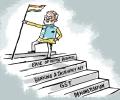
India's GDP expanded 13.5 per cent in the April-June quarter, the quickest pace in a year, to retain the world's fastest growing economy tag but rising interest costs and the looming threat of a recession in major world economies could slow the momentum in the coming quarters.
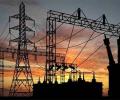
The monthly electricity bills of the majority of domestic consumers in Delhi -- who use more than 200 units and up to 600 units -- will be hiked by up to Rs 265 due to an increase in the power purchase adjustment cost (PPAC) levied by discoms in the city, officials said on Monday.

NSO has pegged economic growth at 5 per cent in 2019-20 in its second advance estimates.

The second-quarter GDP numbers are scheduled to be announced on Friday.
.jpg)
The agency has kept its FY15 growth forecast unchanged at 5.6 per cent.

Billionaire Mukesh Ambani's Reliance Industries Ltd climbed two spots to No. 53 on Forbes' latest Global 2000 list of public companies worldwide. Forbes Global 2000 ranks the largest companies in the world using four metrics: sales, profits, assets and market value, Forbes said releasing the 2022 ranking of the world's top 2,000 companies. Reliance is the top-ranked Indian firm on the list, followed by State Bank of India at No. 105, HDFC Bank at No. 153 and ICICI Bank at No. 204.

The International Monetary Fund, in its latest World Economic Outlook, projected an average growth rate of about 3.8 percent in market prices for India in fiscal 2013, which is expected to pick up to 5.1 per cent next year.

Niti Aayog CEO Amitabh Kant on Tuesday said it is difficult to carry out tough reforms in India and emphasised that more reforms are needed to make the country competitive in the global environment. Addressing a virtual event organised by Swarajya magazine, Kant said for the first time, the Centre has carried out hard reforms across sectors, including mining, coal, labour, agriculture, and the next wave of reforms must be pushed by the states.

The early results from corporate India for the first quarter of 2015-16 are in, and these strongly suggest that a cyclical recovery is underway.

India's economy grew by 1.6 per cent in the fourth quarter of 2020-21, restricting the full-year contraction to 7.3 per cent, official data showed on Monday. The fourth quarter growth was better than the 0.5 per cent expansion in the previous October-December quarter of 2020-21. The gross domestic product (GDP) had expanded by 3 per cent in the corresponding January-March period of 2019-20, according to data released by the National Statistical Office (NSO).

The economic growth slowed to a decade low of 5 per cent in the 2012-13 fiscal.

Index of industrial production data had also shown that the sector grew at 3.1 per cent after contracting in the previous quarters.

Standard Chartered on Friday lowered India's growth forecast for the current financial year to 4.7 per cent from earlier 5.5 per cent, citing "upside risks" to inflation and fiscal deficit.

Imports too declined by 16.31 per cent to $37.39 billion.

He also asked men to work towards securing for women their due place in society.

Marking the end of strict banking secrecy practices, Switzerland earlier this month agreed to automatic exchange of information and mutual administrative assistance in tax matters with overseas authorities.

Chief economist at State Bank of India has revised downward the full-year growth forecast to a low 6.8 per cent from 7.5 per cent earlier for FY2023, citing "the way below GDP numbers for the first quarter". The National Statistical Office on Wednesday released the Q1 growth numbers which showed a consensus growth of 13.5 per cent, pulled down by the poor show of the manufacturing sector, which reported a paltry 4.8 per cent expansion in the first three months of FY23, negating the robust show by the services sector. Consensus forecast was 15-16.7 per cent of which the RBI made the highest forecast of 16.7 per cent.

Donations from corporates to the national parties increased by 109 per cent between FY 2017-18 and 2018-19, said an analysis by the Association for Democratic Reforms (ADR), an NGO working for bringing in transparency in electoral politics.

I suggest we build a Vigyan Mandir (Temple of Science) with the ambience of a place of worship, so that it becomes a destination for pilgrims. We should embed on its walls bronze plaques describing each scientist mentioned here along with about a dozen of our ancient mathematicians, recommends Professor Kalyan Singhal, historian of science and technology.

According to reports, public transport and banking services remain partly disrupted for the second day in some states.

At a time when most of the public sector undertakings across India are reeling under various problems, Gujarat Mineral Development Corporation has proved to be a jewel in the crown of Gujarat.

Investment in infrastructure was necessary for the economy, as power shortages, inadequate transport and poor connectivity affect overall growth performance, as per the Economic Survey 2019-20 tabled in Parliament by Union Finance and Corporate Affairs Minister Nirmala Sitharaman. "To achieve GDP of USD 5 trillion by 2024-25, India needs to spend about USD 1.4 trillion (Rs 100 lakh crore) over these years on infrastructure so that a lack of infrastructure does not become a constraint to growth," it said.

The real estate sector in Maharashtra foresees a loss of Rs 2,000 crore (Rs 20 billion) due to the ban on extraction of sand by the Bombay High Court. The realty industry has sought the intervention of the state government to tackle the crisis.

The World Bank has retained India's economic growth forecast for the current fiscal at 8.3 per cent as the recovery is yet to become broad-based. As per the first advanced estimates of the national income released by the National Statistical Office (NSO) last week, the economy is projected to grow at 9.2 per cent in 2021-22, surpassing pre-COVID level in actual terms, mainly on account of improved performance, especially in farm, mining and manufacturing sectors. "India's economy is expected to expand by 8.3 per cent in fiscal year 2021/22 (ending March 2022), unchanged from last June's forecast as the recovery is yet to become broad-based.

More and more CSR is being defined by how a company runs its operations and makes its profits; and just firms donating money to charities.

10 high dividend paying stocks across sectors that are expected to maintain or even increase their pay-outs in FY23 thanks to faster earnings growth in the last four quarters.
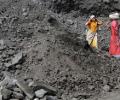
The economy can't grow without increasing electrification, which requires more power plants, and given coal is the cheapest form of fuel and is abundant, it makes sense that India is looking to boost the use of the fuel.

Manufacturing sector grows at 3.5%; agriculture sector at 3.8%

The country's near-term outlook hinged on a benign inflation trajectory, uptick in industrial activity and falling crude oil prices

The status of the current submarine force level is alarming and we need to address the threat perceptions expeditiously. Critical decisions pertaining to national security cannot be delayed any further due to the rapidly changing maritime threat perceptions and growing strategic importance of the Indian Ocean region, asserts Commodore Venugopal Menon (retd).

Moitra brought two birthday caps in the House to press her argument that the businessman being most talked about had "topi-pehnau-ed" the government.

The country's gross domestic product (GDP) is likely to grow more than 9.5 per cent in fiscal 2021-22, an SBI research report-Ecowrap said. The economy grew at 8.4 per cent in the second quarter of the current fiscal, according to data released by the National Statistical Office (NSO) on Tuesday. The growth in the April-June quarter of this fiscal stood at 20.1 per cent. In October's monetary policy review, the Reserve Bank of India had retained its projection for real GDP growth at 9.5 per cent in 2021-22, consisting of 7.9 per cent in Q2; 6.8 per cent in Q3; and 6.1 per cent in Q4 of 2021-22.
